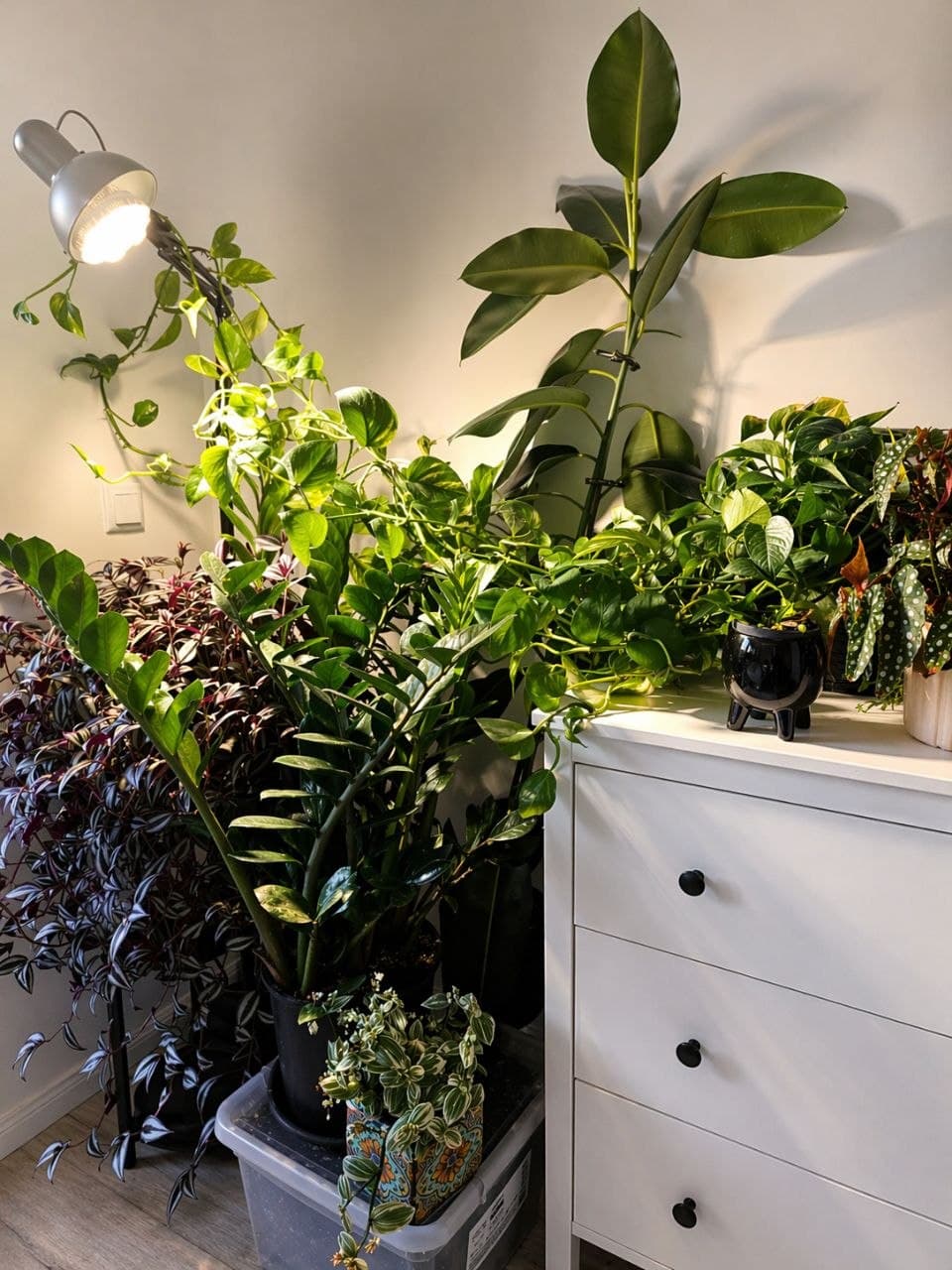
Category: Plant Care · Reading time: 5 min
If your plant looks tired, pale, or is growing small leaves and stretching its stems toward the window — it's probably not a watering issue. It's light.
Light is the one care factor that, when done right, forgives almost every other mistake. A well-lit plant tolerates delayed watering, low humidity, or imperfect soil far better than one kept in the shade. Without adequate light, no care routine will produce visible results.
Why Natural Light Is Often Not Enough
Many apartments have north- or east-facing windows with weak, indirect light — especially from October through March. Even a south-facing window may not be enough if your plant sits 2–3 metres away from the glass.
Something I notice consistently in consultations: people overestimate the light in their space. A room that feels bright to you may only offer 200–400 lux to your plant — enough for survival, but not for healthy growth and a beautiful appearance.
I use a professional lux meter in consultations precisely for this reason: to measure exactly how much light your plant receives, not to guess. The difference between 300 lux and 1,500 lux is invisible to the human eye — but for a plant, it's the difference between stagnation and thriving.
What Full Spectrum Means and Why It Matters
Sunlight contains all wavelengths: blue (400–500 nm), green, red (600–700 nm), and far-red. Plants primarily use blue and red light for photosynthesis.
- Blue spectrum drives vegetative growth — dense foliage, compact form, rich colour
- Red spectrum stimulates flowering and fruiting
- Full spectrum mimics natural sunlight and supports the plant through all growth phases
A standard household LED or energy-saving bulb doesn't provide the right spectrum. The plant perceives it as weak, incomplete light — even if it looks bright enough to you.
The Grow Lights I Use and Recommend
After testing various solutions over time, I've settled on a few brands that consistently deliver good results for indoor plants.
Spider Farmer
One of the best value-for-money options for full spectrum grow lights. The SE and SF series work well for small to medium spaces — a shelf, a dedicated plant corner, or a supplemented window. Light distribution is uniform, visually warm, and energy-efficient.
Barrina
An accessible option for full spectrum LED bars. Works particularly well for layered shelving or plants arranged in a row. Colour temperature around 3000–6000K covers both necessary spectra.
What to Look for in Any Grow Light
- PPFD (Photosynthetic Photon Flux Density): minimum 50–100 µmol/m²/s for low-light plants, 200–400 for active tropical species
- Spectrum: explicitly stated as "full spectrum" or shown with an emission graph
- Distance from plant: most lights work best at 20–40 cm
- Daily light duration: 12–16 hours with a timer
Signs Your Plant Needs More Light
The signals are clear once you know what to look for:
- New leaves smaller than existing ones
- Long, thin stems reaching toward the light source (etiolation)
- Faded colours — green turns yellowish, variegation disappears
- Growth stopped or extremely slow even in spring
- Soil stays wet for a long time — the plant consumes little because it photosynthesises little
How I Assess Lighting in Consultations
When a client describes a plant that "isn't doing well" and the care routine seems correct, light is the first thing I check. With the lux meter I measure actual intensity at the plant's location — morning, midday, and evening — and compare it against the specific requirements of that species.
Often the solution isn't a new lamp — just moving the plant 50 cm closer to the window. Other times, especially in winter, a grow light changes everything.
If you're not sure how much light your plants are receiving, I can assess this precisely during a consultation.
The Bottom Line
Light isn't a detail — it's the foundation of successful plant care. A well-lit plant forgives mistakes. A plant kept in shadow suffers no matter how carefully you tend to everything else.
If you want to know exactly what light your plants are getting and which solutions fit your space, write to me — I bring the lux meter and concrete recommendations.
RootsFit Studio · Premium botanical consultancy for indoor plants